 Dutch
Dutch  English
  Spanish
  Japanese
  French
  Portuguese
  German
  Russian

It’s so exciting to pick out stunning vessels and mix custom fragrances. But honestly, none of that matters if your candle doesn’t burn well. When brand founders come to me frustrated about soot or failed burn tests, the culprit is almost always the wick. Understanding the different types of candle wicks is the real secret to a safe product and happy customers.
Running the manufacturing floor single-handedly at Oenus Deco means I spend hours testing wick-to-wax ratios for my B2B partners. Just last month, I was working on a wholesale order of 140 ceremonial candles for my French client, Steve. The success of that entire batch came down to matching the exact wood density to his custom wax blend. Let’s chat about picking the right wick, so you can skip the costly mistakes.
What Can Be Used As A Candle Wick? (Please Skip the DIY Route!)
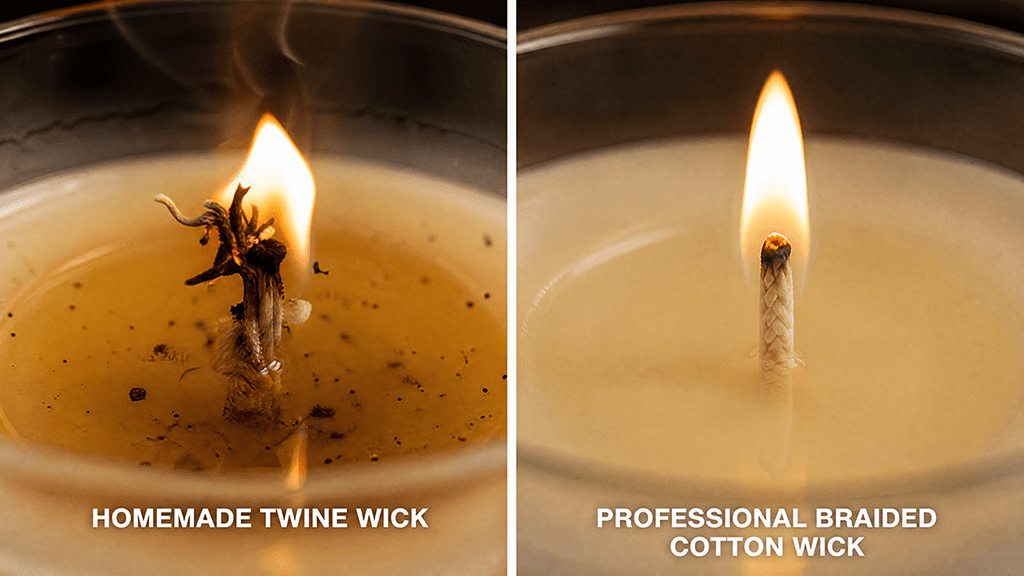
I often see new boutique owners searching for how to make a candle wick or trying out a diy candle wick using twisted twine. While a homemade candle wick is a fun weekend craft, it is a nightmare for a retail brand.
Untreated materials burn unpredictably and are a huge safety liability. Professional manufacturing requires precision-braided, chemically treated materials that meet strict National Candle Association safety standards. You really need to stick to one of the three main commercial types of candle wicks.
Cotton, Eco, or Wood: Breaking Down the Big Three
Let’s look at the pros, cons, and how we handle them in the workshop to ensure your bulk orders are flawless.
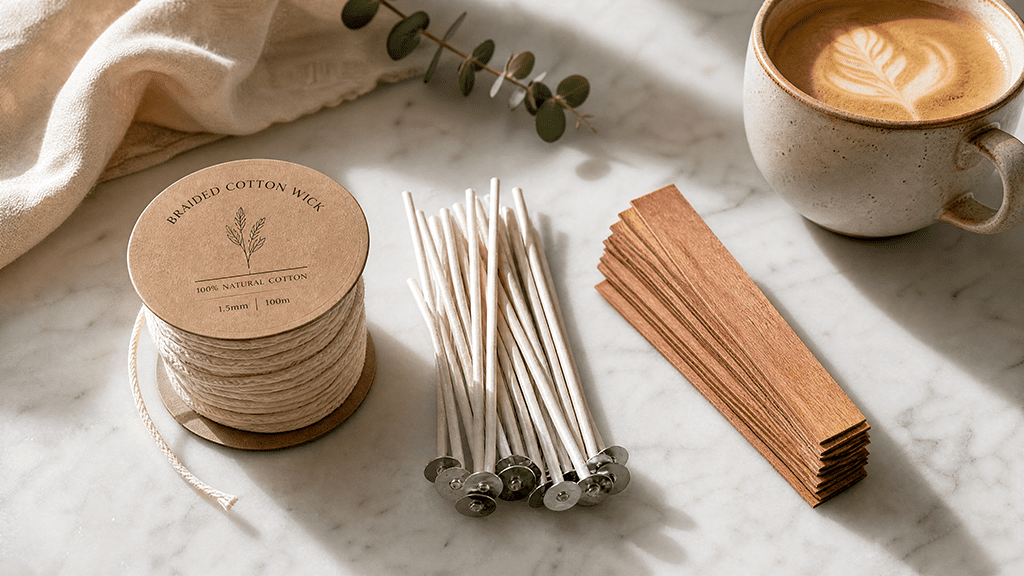
1. Cotton Wicks (The Classic Choice)
They are the industry standard for a very good reason.
- Pros: Pure cotton gives a quiet, stable flame and looks incredibly clean in the jar.
- Cons: They are soft. If you aren’t careful, they lean over while burning, causing uneven melting.
- Our Fix: During mass production, we lock your cotton wicks in place with heavy-duty sustainer tabs and rigid centering tools while the wax cools. They stay perfectly straight.
2. Eco-Friendly Wicks (The Sturdy Option)
These are woven with paper or rigid natural fibers.
- Pros: They are naturally stiffer, so they don’t lean like standard cotton. Plus, eco-conscious buyers absolutely love them.
- Cons: They can suffer from carbon buildup (that little “mushroom” on top), which leads to black smoke if not trimmed.
- Our Fix: We prevent this by matching the paper core precisely to the viscosity of your wax, so it doesn’t soak up fuel too fast.
3. Wooden Candle Wicks (The Luxury Vibe)
A wood candle wick totally changes the vibe of your product.
- Pros: A good wooden candle wick crackles softly like a tiny fireplace, creating an amazing atmosphere.
- Cons: They are finicky. If the wood is too thick, the flame gets huge. If it’s too thin, it drowns in melted wax.
- Our Fix: Wood requires exact science. We run strict burn tests to match the wood density perfectly to the melting point of your specific wax.
How to Actually Choose the Right Wick for Your Brand
So, how do we make the final call between cotton, wood, or eco? When we start a new custom project, we look at three crucial details to guide your choice:
- Your Wax Blend: Dense natural waxes (like 100% soy) usually need a thicker cotton wick or a stiff eco-wick to pull the liquid up efficiently. Softer blended waxes are a bit more forgiving.
- Vessel Diameter: A standard, narrow jar works beautifully with a single cotton wick. But if you are using a wide bowl (over 3 inches), we will likely need a wider wooden wick or a double-cotton setup to ensure the wax melts all the way to the glass.
- Fragrance Load: Heavy scent oils can easily clog a wick. If your candle is super fragrant, we often need to size up the wick to keep that flame burning bright and strong.
The Missing Link: What is the 3-Hour Rule for Candles?
Now, let’s say we’ve done everything perfectly in the workshop. We picked the ideal wick, matched it to your wax, and shipped it out. Are we safe from tunneling? Not quite!
Even the best wick in the world can’t fix human error. This is where I always ask my brand founders: What is the 3-hour rule for candles?
It’s a simple rule that says on the very first light, a candle must burn for about three hours—or until the melted wax reaches the very edges of the jar. If your customer blows it out too early, it creates a “memory ring.” From then on, the candle will tunnel straight down the center, no matter how perfectly we designed it.
I always advise my clients to print this 3-hour rule on their warning labels. When we combine our expert wick matching with educating your buyers, tunneling complaints practically vanish.
Let’s Build Your Private Label Together
Selecting the right types of candle wicks shouldn’t be a headache. You have a business to grow. You have a business to grow, and you shouldn’t have to stress over soot or failed burn tests. At Oenus Deco, I personally handle the testing, the matching, and the mass production. We offer flexible Low MOQs, so boutique owners can launch premium lines without tying up all their cash in inventory.
Ready to stop worrying and start selling? Check out our flexible manufacturing options and Your Contact/Private Label Page let’s chat about a customized wholesale quotation for your next line today!
