 Russian
  English
  Spanish
  Japanese
  French
  Dutch
Dutch  Portuguese
  German
В корзине нет товаров.

For businesses looking to scale a home fragrance brand, scaling manufacturing involves looking far more deeply than beautiful aesthetics and curated scent profiles. Scented candles are consumer goods that carry inherent thermal risks, meaning they are closely monitored by consumer safety groups and trading standards in Western countries.
When you purchase wholesale orders for retail distribution, minor compliance oversights can easily turn into unexpected costs, shipment delays, or product recalls.
To keep your inventory moving smoothly, you need a straightforward framework to reduce shipping and regulatory risks. This practical guide breaks down the core pillars of candle safety compliance you need to verify before your next container leaves the factory floor.
Quick Answer: Key Compliance Checks
Before importing candles into the US or Europe, volume buyers should verify five key candle safety compliance requirements:
Customs Documentation: Ready-to-use customs entry forms and chemical profiles.
ASTM and EN Standards: Verified fire safety testing parameters for finished goods.
SDS and Chemical Transparency: Complete safety data sheets for correct cargo classification.
Warning Labels: Clear base tracking graphics with mandatory hazard icons.
Supplier Audits: Upstream vetting of materials, wicks, and wax blends.
Verifying these steps helps you avoid port holds, custom rejections, and inventory scrap risks.
Table of Contents (Automatically Generated by Theme)
1. Market Access: Can Your Candles Be Sold Legally?
Your products must satisfy distinct regional legal frameworks before they can be showcased on retail shelves. Meeting these requirements ensures that your brand builds long-term trust with major retail chains and boutique buyers alike.
The European Union Market and GPSR Mandates
In Europe, the General Product Safety Regulation (GPSR) sets a strict compliance benchmark for all consumer goods. Depending on your distribution model, products sold in the EU may require clear traceability information, including importer or responsible economic operator details and batch codes in accordance with GPSR requirements.
The United States Market and CPSC Rules
In the US, the Consumer Product Safety Commission (CPSC) regulates home fragrance items. Legal placement requires aligning your manufacturing with established fire safety parameters, ensuring you maintain reliable candle safety compliance across your entire product catalog.
Sourcing high-quality wholesale-scented-candles successfully means understanding that compliance is checked at the finished product level. Reputable factories will always provide unbranded testing samples and fully support your brand when submitting items to independent third-party laboratories like SGS, Intertek, or TÜV Rheinland.
2. Customs Clearance: Avoiding Port Delays
Logistics bottlenecks at the port of entry can quickly drain your retail margins through unexpected demurrage fees. Customs authorities inspect candle shipments carefully to ensure they do not contain hidden hazardous chemicals or restricted substances.
To ensure frictionless transit, your supply chain must be anchored by complete chemical transparency. If your fragrance oil formulations include specific aromatic compounds that exceed regional allergen thresholds, they must be declared cleanly under standard REACH and CLP classifications.
The most practical tool to streamline this process is ensuring your supplier provides an up-to-date, 16-section Safety Data Sheet (SDS) for every item in your container. An up-to-date SDS helps customs brokers and freight forwarders classify the shipment correctly and determine whether the products can be transported under standard conditions.
Documents to Prepare
When organizing your import logistics, make sure your paperwork file includes these five essential items:
| Document | Purpose | Key Verification Point |
| Safety Data Sheet (SDS) | Chemical information | Helps classify the shipment correctly under standard conditions |
| Commercial Invoice | Customs declaration | Matches the exact itemized description of the candle order |
| Packing List | Shipment details | Outlines box counts and pallet configurations accurately |
| Bill of Lading (B/L) | Freight document | Issued cleanly by the ocean or air shipping line |
| Test Reports | Safety verification | Validates physical burn safety under current lab conditions |
3. Product Safety Testing and Performance
Product performance in the end-consumer’s home is where your brand reputation is built. Poor material sourcing leads to common quality issues like excessive black smoke or cracking glass containers during long burn cycles.
Preventing these defects requires proper candle safety compliance testing during the product development phase. Importers should double-check container integrity, ensuring that glass or ceramic vessels match thermal shock standards to handle the continuous heat generated by liquid wax pools.
Similarly, choosing balanced candle wax types guarantees an even burn without generating dense soot lines. Achieving a clean, reliable burn depends on meticulous wick-to-wax compatibility, utilizing lead-free cotton or eco-friendly wooden wicks that match the diameter of the specific vessel to eliminate smoke generation and excessive flame height before mass production.
4. Brand Protection: Managing Liability and Insurance
Operating a retail network or e-commerce storefront in Western markets requires robust liability protection. Many retailers and distributors may also request proof of product liability insurance before listing new products, which is a common focus for established brands sourcing product liability insurance for candles.
Insurance underwriters routinely require verified safety testing reports before issuing commercial policies. Outside of laboratory documentation, your primary tool for managing brand risk is your retail packaging layout.
(Visual Suggestion: Minimalist diagram highlighting the standard placement of candle warning symbols on a box base)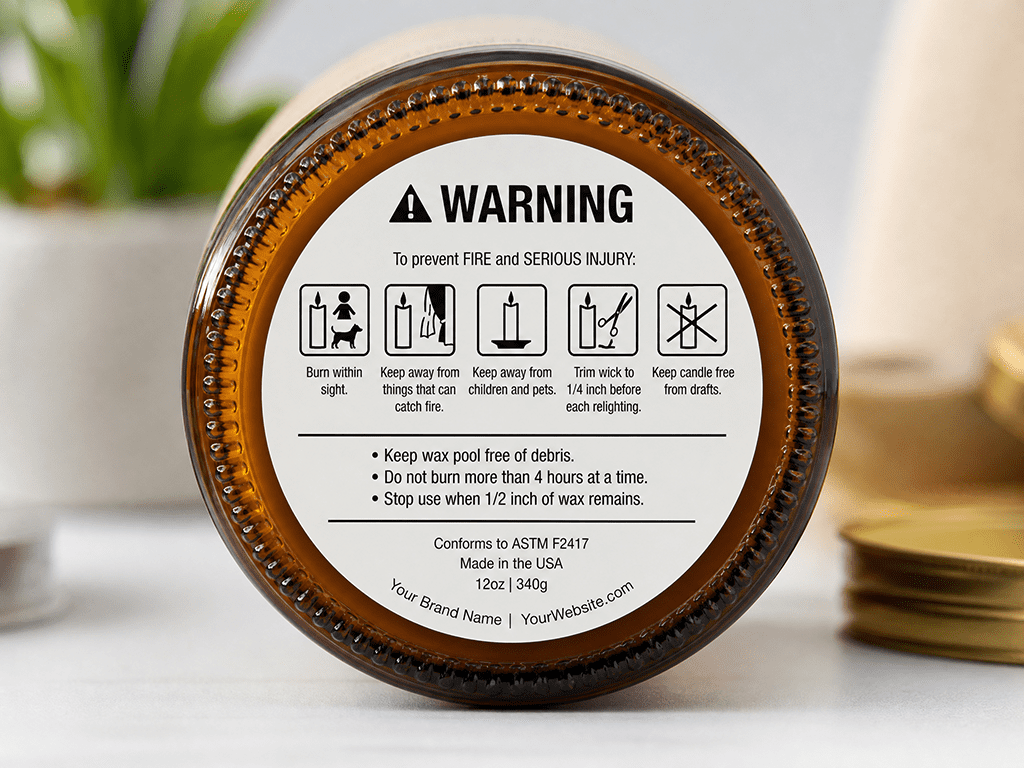
Integrating standardized, highly legible candle safety labels on the bottom of every jar provides clear operational instructions for the consumer. These warning sections must feature universal pictograms alongside clear candle safety tips, ensuring your products satisfy local trading standards while naturally blending with your luxury design aesthetic.
5. Supplier Audits
Vetting your manufacturer’s production habits is the final step to protecting high-volume orders. A proactive supplier prevents structural and chemical errors before mass production begins, helping maintain consistent performance across large production runs.
Avoid Reveal Candles and Decorative Additives
While incorporating decorative items like dried flowers, crystals, or hidden metallic jewelry inside wax blends is popular on social media, these additives present significant fire risks. Combustible materials floating in a hot wax pool cause unstable flames and fail international fire safety checks. Even though independent artisans frequently exchange unverified Candle Reveal Safety Advice on public forums, professional manufacturing operations prioritize clean, safe formulations over volatile visual trends.
Working With Experienced Manufacturers
Partnering with an industrial facility that understands international safety frameworks saves your team time and capital. An experienced partner can adapt printing lines for localized safety labels, handle chemical reporting sheets smoothly, and help you scale your brand with total peace of mind.
Need Help With Candle Compliance?
At Oenus Deco, we help private label brands and distributors simplify documentation, warning label design, and low-MOQ manufacturing support.
Whether you are launching a new fragrance collection or expanding your seasonal retail inventory , our team can help you streamline candle safety compliance and reduce sourcing risks.
If you are interested in developing custom private label candles built to international safety margins, request samples or contact us to discuss your next project today.
 [Request samples or contact us to discuss your next project today.]
External Authoritative Industry Resources
To review the exact testing metrics and regulatory framework developments driving Western retail sectors, consult the official protocols provided by leading trade networks:
- For verified data on global wax chemistry definitions and burn dynamics, view the industry resources cataloged by the National Candle Association (NCA).
- For detailed guidance on emerging European product traceability laws and packaging updates, read the direct compliance frameworks managed by the European Candle Association (ECA).
